
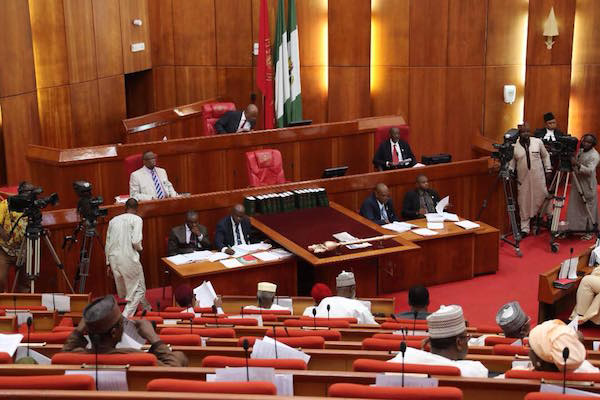
The Senate has initiated a high-stakes probe into the utilization of the ₦15 billion disbursed for the Safe Schools Initiative (SSI) in 2023, raising serious concerns over financial transparency, particularly regarding the Nigerian Police Force’s allocation of ₦6.225 billion—the single largest amount released.
These concerns were voiced by Senator Orji Uzor Kalu (APC, Abia North), Chairman of the Senate Ad-hoc Committee investigating the programme’s implementation, following the committee’s grilling of the National Coordinator of Financing Safe Schools in Nigeria, Hajia Halima Iliya.
The committee is actively querying reports of financial irregularities, including questionable consultancy spending, within the multi-agency security programme established to protect educational institutions from terrorist attacks and mass abductions.
Senator Kalu mandated a full reconciliation of all financial records and directed the Safe Schools Financing Office to return with a comprehensive and rectified breakdown of all funds released, expenditures made, names and details of contractors, and complete documentation from the Central Bank of Nigeria (CBN) Trust Fund account. He stressed that the committee would not proceed without clear and verifiable records.
Appearing before the committee, Hajia Iliya traced the origins of the SSI to the 2014 abduction of 276 Chibok schoolgirls, which prompted the programme’s launch under former President Goodluck Jonathan in collaboration with international partners.
She provided a list of major historical contributions to the CBN-domiciled Trust Fund, including: Federal Government — $10 million (₦1.5 billion); Nigerian business leaders — $10 million (₦2 billion); African Development Bank — $1 million (about ₦200 million); German Government — €2 million (about ₦1 billion); Norwegian Government — $4 million (managed by UNICEF); UN Multi-Donor Trust Fund with contributions from UNICEF, UNDP and UNOPS; and a combined $4 million from USAID and the Qatar Foundation.
Regarding the specific 2023 federal release of ₦15 billion under investigation, Iliya confirmed the allocations: the Nigerian Police Force received the bulk with ₦6.225 billion; the Nigeria Security and Civil Defence Corps (NSCDC) was allocated ₦3.362 billion; Defence Headquarters received ₦2.250 billion; and the Federal Ministry of Education got ₦519 million. The precise amount allocated to the Department of State Services (DSS) was not publicly disclosed during the session.
Iliya also noted that the Safe Schools Financing Office currently has no budgetary allocation in 2024 and 2025, explaining that its request for inclusion in the 2024 fiscal year was submitted too late to reach the President.
Tension rose during the hearing when Senator Oluranti Idiat (APC, Lagos Central) challenged the coordinator on the efficiency of previous spending, particularly the ratio of administrative costs to project execution.
“You have used almost half of ₦4.44 billion for consultancy and operational expenses and spent about ₦4 billion on the project itself. Don’t you think that is why you are not getting another budget?” Idiat asked.
Iliya countered, stating the documents being referred to related to the 2014 funding cycle and not the 2023 release. Idiat sharply replied: “You’re not doing us a favour. Please withdraw that statement.”
Further concerns were raised by Senator Musa Maidoki (APC, Kebbi South), who questioned the policy rationale of separate allocations to security agencies, arguing that Safe Schools funding should be strictly tied to performance and domiciled closer to communities for effective oversight.
Similarly, Senator Kenneth Eze (APC, Ebonyi Central) voiced fears of possible misappropriation, contending that the financial submissions lacked clarity and authenticity, and that the disclosed consultancy expenses raised serious red flags.
The Senate committee emphasized its commitment to thoroughness, vowing to continue the probe and insisting that no further steps would be taken until complete, transparent, and verifiable records are presented by the financing office.