


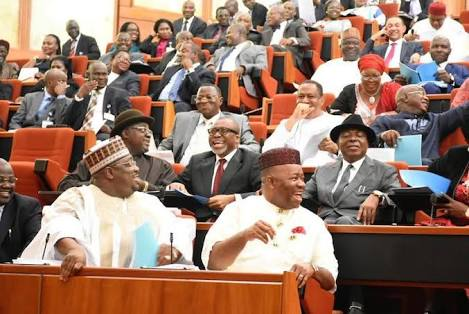
Following a dramatic shake-up in Nigeria’s petroleum regulatory landscape, President Bola Tinubu’s new nominees for the country’s top energy roles have pledged to implement sweeping reforms centered on transparency, digitization, and energy security.
The Senate screening on Thursday comes less than 24 hours after the resignations of Farouk Ahmed (NMDPRA) and Gbenga Komolafe (NUPRC). Oritsemeyiwa Eyesan has been tapped to lead the Nigerian Upstream Petroleum Regulatory Commission (NUPRC), while Engineer Saidu Mohammed is set to head the Nigerian Midstream and Downstream Petroleum Regulatory Authority (NMDPRA).
The exit of the previous executives drew sharp reactions from lawmakers, notably Senator Adams Oshiomhole, who remarked during the proceedings that he hopes to drink to Farouq’s resignation.
A Digital Leap for the Upstream Sector
Oritsemeyiwa Eyesan, an industry veteran with 33 years of experience at the NNPC, told the joint Senate committees that the manual nature of current operations is a significant drain on national wealth.
“We are still largely manual while the world is moving at jet speed. Without digitisation and real-time data, you cannot truly understand what you are regulating, and you will continue to lose money,” she said.
Eyesan emphasized that her leadership would move away from isolated regulation toward a more inclusive model. She noted, “we must collaborate with stakeholders, identify our pain points and address them collectively. That is how we move the needle forward.”
Describing the Petroleum Industry Act (PIA) as a “valuable document,” she vowed to use the framework to attract deep offshore investments and manage the energy transition. Highlighting her readiness for the role, she stated: “Having worked as an operator and participated in resource development, I believe I have the competence to regulate the industry and ensure we maximise the enormous opportunities before us.”
Restoring Contractual Discipline in Midstream and Downstream
Engineer Saidu Mohammed, the nominee for the NMDPRA, focused his presentation on the chaos within the gas supply chain. He argued that the power sector’s instability is often a result of weak legal frameworks rather than lack of resources.
“Gas is not a favour; it is a commodity. It must be sold on the basis of enforceable contracts from the producer to the transporter and the end-user,” Mohammed asserted.
He further warned that Nigeria’s local refining capacity must be shielded from global volatility to prevent the industry from collapsing. Mohammed also expressed a commitment to upgrading the agency’s technical capabilities, stating: “you cannot enforce quality if you do not have the capacity to test and certify products yourself.”
The screening was overseen by a trio of Senate committees led by Senators Kawu Abdulrahman (Downstream), Eteng Williams (Upstream), and Jarigbe Agom Jarigbe (Gas).
Senator Sumaila, Chairman of the Downstream Committee, noted that the timing of these appointments is vital, as boosting energy production and efficiency is central to national economic recovery. He indicated that legislative engagements with the nominees will continue into January to ensure a seamless transition into this new phase of regulation under the Tinubu administration.














 and Gbenga Komolafe (NUPRC).)