

For all the conversations around infrastructure, funding and policy, one idea keeps returning to the centre of Nigeria’s digital economy push. Nothing meaningful scales without collaboration.
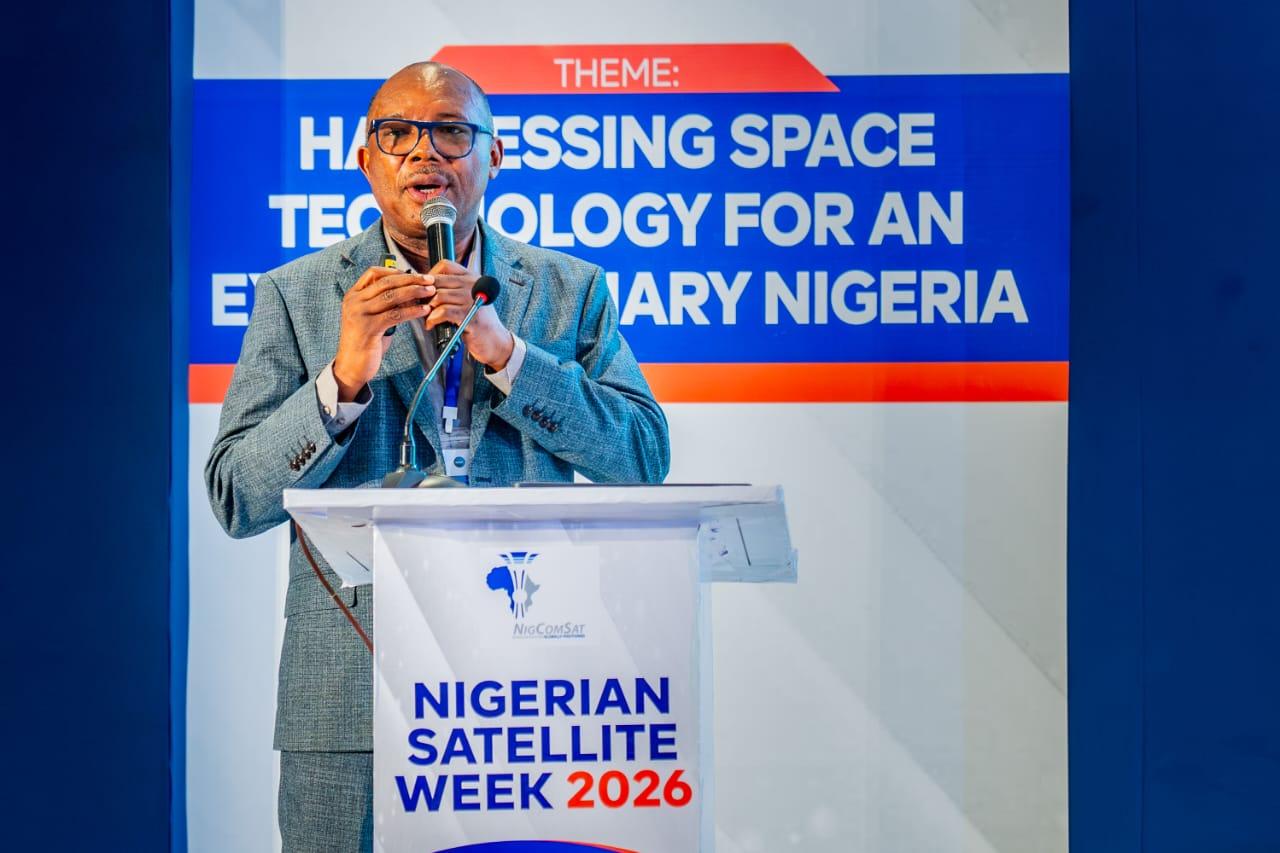
At Nigerian Satellite Week 2026 in Abuja, the National Information Technology Development Agency made that point clearly. The agency is shifting its focus from isolated innovation to connected ecosystems where government, startups and institutions build together, not in silos.
Representing Director General Kashifu Inuwa, Dr Aristotle Onumo framed the conversation around a practical reality. Ideas alone do not move economies. Execution does, and execution depends on partnerships that turn small solutions into scalable systems.
“Take a good step, and you can make a difference,” he said, urging stakeholders to move from conversation to coordinated action.
That framing shaped the entire discussion. According to NITDA, digital transformation is no longer about controlling systems from the centre. It is about enabling ecosystems where innovation can grow organically.
The agency outlined a working approach that prioritises networks over institutions, talent development alongside innovation, and platforms over one off projects.
To bring that idea closer to reality, Inuwa pointed to a simple but telling example. A rural farmer struggling with unstable income and limited access to credit was able to improve productivity through digital tools and connected platforms.
What starts as a small intervention at that level, he explained, can scale into wider economic impact when systems are properly linked.
“This is the power of space technology, and it shows why events like this are so important,” he said.
That connection between local problems and global systems is becoming more visible. Space technology, once dominated by a handful of global powers, is now opening up to startups working across telecommunications, navigation, security and cloud infrastructure.
In Nigeria, projections suggest that the sector could contribute more than 1.5 billion dollars to the economy by 2030.
However, growth in that space depends on a clear shift in how government supports innovation.
“Innovation without adoption is wasted,” Inuwa said, stressing that regulation must create opportunities, not barriers. He explained that government’s role should be to build markets, support ecosystems and enable innovators to scale.
That approach is already influencing policy and programmes. Initiatives such as the Digital Start-Up Act, Idea Hatch and the National Digital Leadership Programme are designed to connect young innovators with funding, mentorship and global exposure.
Platforms like GITEX Africa, GITEX Nigeria and Digital Nigeria are also being used to attract investment and partnerships.
At the same time, infrastructure is expanding to support that growth. Speaking at the event, Minister of Communications, Innovation and Digital Economy, Bosun Tijani, highlighted ongoing investments in fibre networks, telecom towers and satellite capacity.
“Nigeria is the only West African country with its own satellite. NigComSat provides critical connectivity and resilience,” he said, adding that new satellite deployments have already been approved to strengthen coverage and regional reach.
Still, he was careful to draw a line between infrastructure and impact.
“What truly matters is how we leverage this technology to improve agriculture, education, security and business operations,” he added.
That distinction is important. Across sessions at the event, the message remained consistent. Technology on its own does not transform economies. It is how people use it, and how systems connect, that determines outcomes.
From the perspective of Nigerian Communications Satellite Limited, the shift is already visible. Managing Director Jane Egerton-Ideyen noted that the country’s space programme is moving away from prestige driven projects toward practical applications that improve livelihoods and expand access.
As Nigeria continues to build its digital economy, the direction is becoming clearer. The next phase will not be defined by standalone initiatives or fragmented systems.
It will be defined by how well institutions, startups and infrastructure work together.
Because at this stage, collaboration is no longer a strategy. It is the difference between progress that is visible and progress that actually scales.