
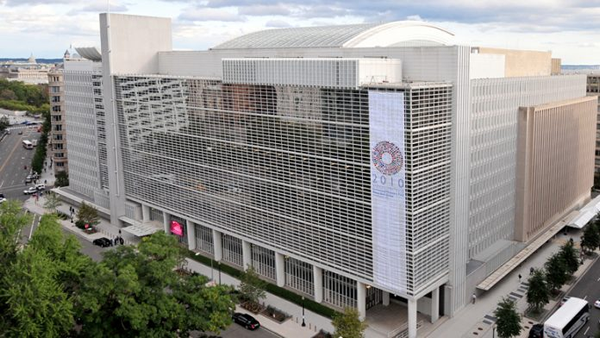
The World Bank has revealed that poverty levels in Nigeria climbed to 63 per cent in 2025, underscoring the limited impact of easing inflation on the living conditions of millions of households.
The finding was contained in the Nigeria Development Update (April 2026) titled “Nigeria’s Tomorrow Must Start Today: The Case for Early Childhood Development,” unveiled in Abuja.
According to the report, the proportion of Nigerians living below the poverty line rose steadily from 56 per cent in 2023 to 61 per cent in 2024, before reaching 63 per cent in 2025—equivalent to roughly 140 million people.
This increase occurred even as inflation showed a marked decline. Data from the National Bureau of Statistics indicated that headline inflation dropped from 34.80 per cent in December 2024 to 15.15 per cent in December 2025. Food inflation also fell sharply from 39.84 per cent to 10.84 per cent within the same period.
Despite this moderation, the World Bank said the relief has not translated into improved welfare for households, as earlier price surges had already weakened purchasing power.
It stated, “Household incomes have not grown fast enough to offset still-elevated inflation, and poverty has yet to begin declining.”
The report explained that although inflation is easing, its lingering effects—combined with previous spikes—continue to erode real incomes, leaving many Nigerians worse off.
It also pointed to global pressures, including the Middle East conflict, which have driven up energy, food, and transportation costs, further squeezing household budgets. These developments, the bank noted, are “adding pressure to inflation and poverty, including via food prices,” particularly for low-income families that spend most of their income on basic needs.
Beyond price pressures, the structure of Nigeria’s economic growth was identified as another constraint. The World Bank observed that while services and industry have driven recent growth, agriculture—where the majority of poor Nigerians are employed—has lagged behind.
“Growth in the agriculture sector—where more than half of the poor work—has lagged services and industry, constraining the pace of poverty reduction,” the World Bank stated.
Although the 2025 figures paint a grim picture, the report projected a gradual improvement starting in 2026 as inflation continues to decline and economic conditions stabilise.
It stated, “Despite elevated poverty levels, a gradual decline is expected from 2026 as inflation continues to ease.”
The bank estimates that poverty could fall modestly to about 59 per cent by 2028, driven by lower food prices and moderate economic expansion. However, it warned that progress would likely be slow due to structural challenges such as weak job creation, low agricultural productivity, and persistent inequality.
At the report’s presentation, the World Bank’s Lead Economist for Nigeria, Fiseha Haile, stressed that inflation remains a major obstacle to improving living standards.
He said it “remains high… and it risks eroding real incomes and slowing poverty reduction,” adding that sustained price stability is essential for meaningful welfare gains.
Haile further noted the “critical need to bring inflation down… and promote growth and make sure it’s more inclusive, to make sure that citizens… feel the benefits of the macroeconomic reforms.”
He emphasised that tackling poverty requires not just growth, but growth that generates jobs and raises incomes, particularly for vulnerable populations. He also highlighted the importance of investing in human capital, noting that early childhood development “is the foundation for… productivity, and of course, poverty reduction.”
Also speaking, Nigeria’s Minister of Finance and Coordinating Minister of the Economy, Wale Edun, said the government remains focused on policies aimed at lifting citizens out of poverty.
He described the “ultimate goal” of ongoing reforms as the “lifting Nigerians out of poverty by the millions,” while stressing that macroeconomic stability must be complemented by investment and job creation.
Edun explained that the government is working to create an enabling environment for both large-scale and small business investments, which he identified as critical to reducing poverty levels.
He also reaffirmed the administration’s commitment to social protection for vulnerable groups, especially amid rising living costs.
“There is still that commitment to have in place a social safety net that helps the poorest, the most vulnerable in particular, to cope with elevated costs,” he stated.
According to him, targeted interventions such as direct benefit transfers are being deployed using digital systems to ensure support reaches those who need it most.
He added that such measures would remain central to government policy, noting that supporting vulnerable populations is essential in “any caring society.”
While acknowledging the continued pressure from global energy and food prices, Edun maintained that efforts are ongoing to stabilise the economy and improve living conditions for Nigerians.