


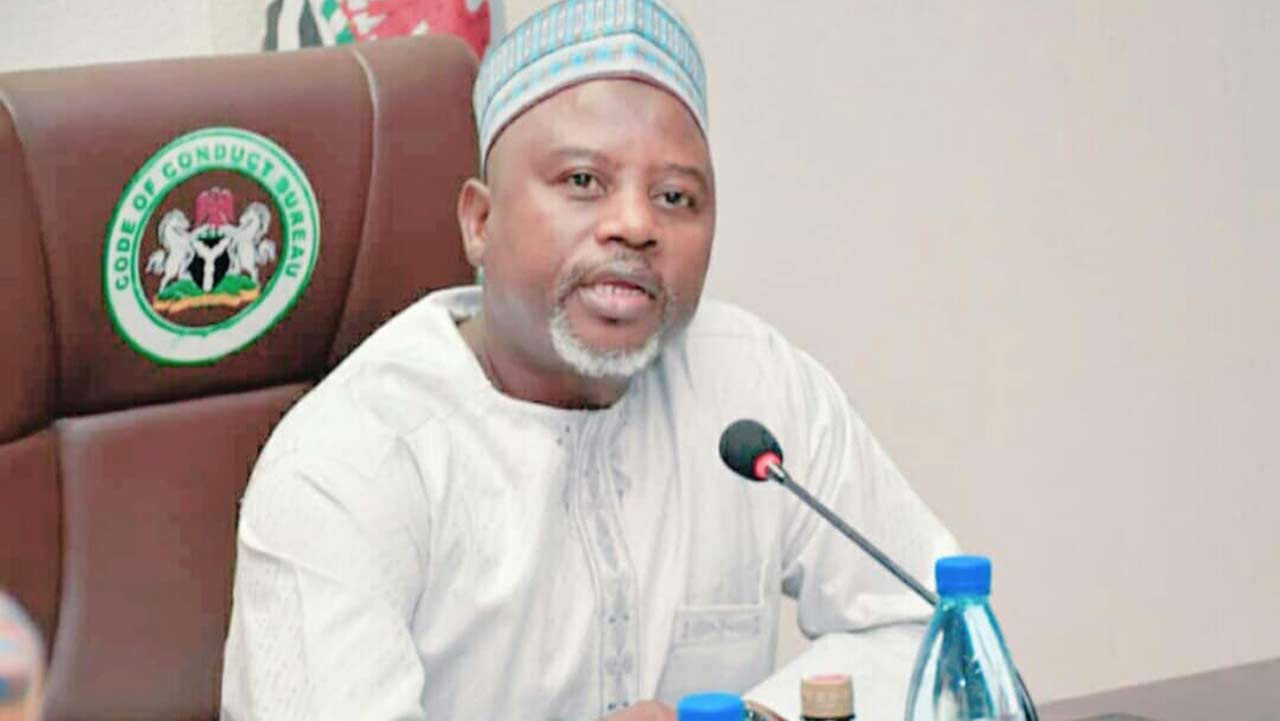
The Chairman of the Code of Conduct Bureau (CBB), Abubakar Bello, says the agency has commenced investigations into high profile corruption cases involving former and current ministers, current top government officials and senior public office holders at both federal and state levels.
Bello who disclosed this in an interview with journalists in Abuja on Sunday, said the bureau got the go ahead for the investigations after it secured interim forfeiture orders from the courts and recorded recoveries from investigations involving local government chairmen and senior state officials.
While dismissing allegations from some quarters that the anti-corruption war was targeting political opponents of the president and members of opposition parties, Bello said on the contrary, those being investigated include serving ministers, senior government officials and other high-profile individuals.
“We have started investigating high-profile individuals. There is a former minister we have already taken to court. Right now, we are investigating another former minister and also a serving top government official,
“I won’t mention names because we are still at the investigation stage. We don’t want to turn it into a media trial,” he said.
The CCB Chairman insisted that Nigeria’s anti-corruption war was not targeted only at low-level offenders while shielding politically exposed persons, as alleged in some quarters.
Bello who defended the bureau’s war against corruption, explained that the agency’s operations were guided strictly by law and due process and not media pressure or political considerations.
“From my experience working with the EFCC, sometimes people write frivolous petitions. Once the media starts reporting it, the person is already labeled corrupt.
“But, if investigations later show he is innocent, his name is already damaged. That is why we only speak when we are ready to go to court,” he noted.
“Every public officer is required to declare assets at the beginning and at the end of their tenure. It is within this window that corruption is detected.
“If you declare your assets at the beginning of your tenure and we verify it, we don’t have any issue with you again until the end of your tenure.
“But if at the end of your tenure you suddenly move from ₦10 million to ₦200 million and you cannot explain the source of that increase, that is where we come in,” he explained.
Bello also noted that the bureau’s investigations were not limited to asset comparisons alone as it also acts on petitions and allegations from members of the public and public servants.
“If there is a petition against you, we investigate. If we find that you did not declare your assets or cannot explain the source of your income, we will take you to court.
“We are talking about 4.5 million public servants in Nigeria. We cannot investigate or verify all of them with the resources. To manage this, the bureau has adopted a risk-based approach, focusing its limited resources on high-risk and high-profile individuals where the impact would be greatest.
“That is why it may look like we are selective, but it is not about protecting anyone. It is about using scarce resources wisely to get the highest results,” he further explained.





















, Abubakar Bello, says the agency has commenced investigations)