
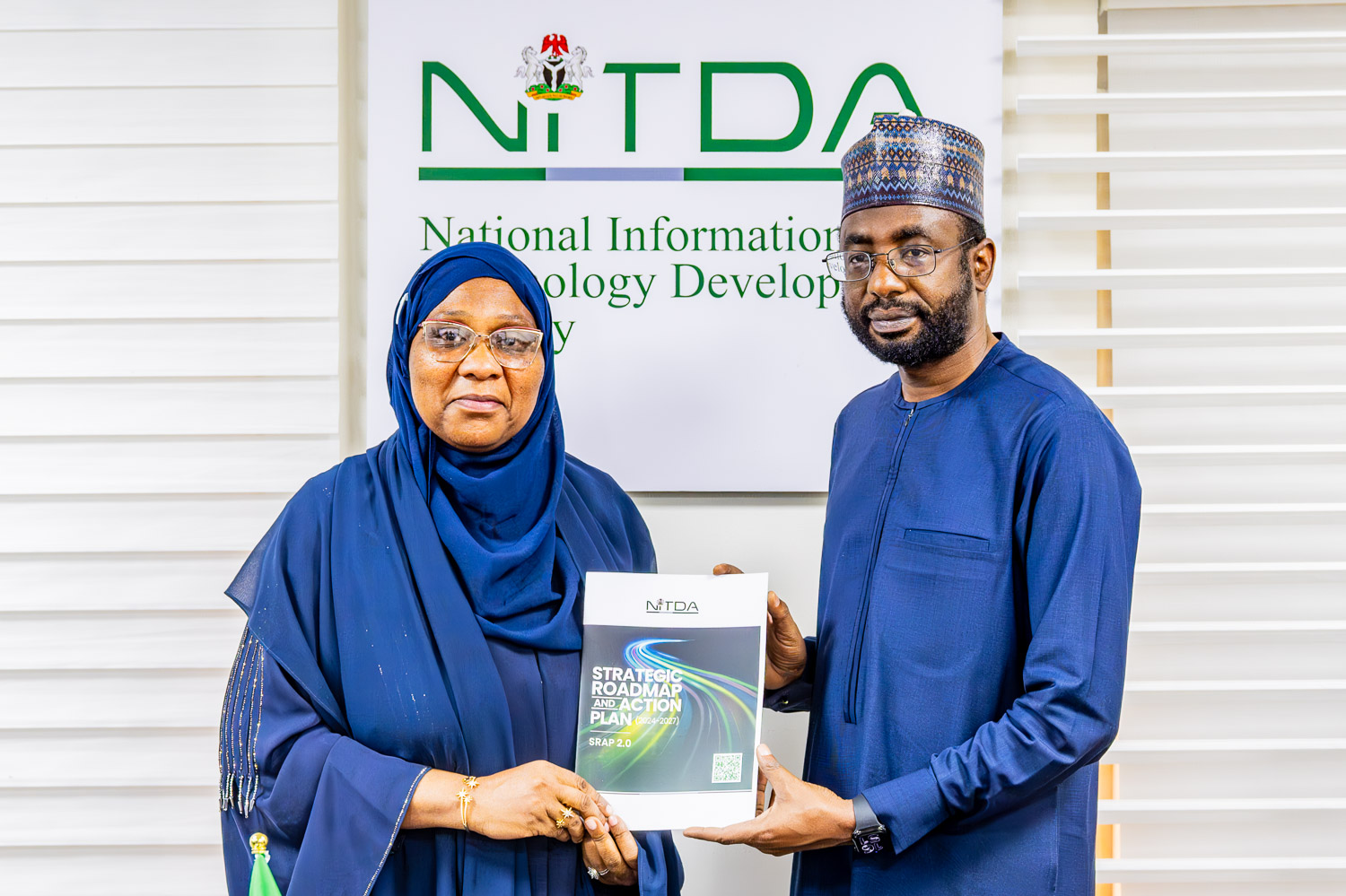
The National Information Technology Development Agency (NITDA) and North West University have commenced discussions on a strategic partnership aimed at strengthening digital capacity, research, innovation and technology-driven education at the institution.
The engagement, which brought together the management of the university and the NITDA leadership, focused on ways technology could be deployed to enhance teaching and learning, research, innovation and the employability of graduates.
Speaking during the engagement, the Director-General of NITDA, Kashifu Inuwa Abdullahi, said the proposed collaboration should be structured to deliver sustainable outcomes rather than one-off interventions.
Inuwa stressed that universities remained critical to Nigeria’s digital transformation, given their role in producing the skilled workforce, research and knowledge required to sustain technological development.
He said the country’s digital development agenda must place greater emphasis on strengthening institutions and equipping the people who would drive the digital economy.
The NITDA boss also identified the mismatch between university training and industry requirements as a major challenge to graduate employability, urging institutions to establish stronger relationships with employers and technology companies.
He called for regular reviews of academic curricula to ensure that students were exposed to emerging technologies and acquired practical skills relevant to both the Nigerian and global labour markets.
“We need to create an ecosystem where the university produces the human capital required by government and the private sector, while industry also contributes to the development of relevant skills and research,” he said.
Inuwa disclosed that NITDA was promoting digital literacy through the National Digital Literacy Framework, urging the university to integrate digital literacy into its General Studies programme.
Beyond basic digital skills, he encouraged the institution to strengthen academic programmes in emerging fields, including Artificial Intelligence, cybersecurity, cloud computing and robotics.
He also urged the university to leverage the National Universities Commission’s Core Curriculum and Minimum Academic Standards framework to develop programmes that respond to technological developments and emerging opportunities in the economy.
The NITDA DG cited the collaboration between NITDA, Nasarawa State University and Cisco as an example of the benefits of partnerships between academia and industry, particularly in providing students with practical exposure, professional certifications and academic recognition.
According to him, the proposed partnership with North West University should extend beyond digital infrastructure to include research and innovation, particularly projects capable of addressing real-world challenges.
He advocated the early involvement of government agencies and private-sector organisations in university research, saying such collaboration would help accelerate the transition of research findings from laboratories and classrooms into practical solutions.
Inuwa identified technical training, innovation laboratories, research collaboration and partnerships with global technology companies as some of the areas in which NITDA could support the university.
He cautioned against measuring digital development by the number of computers and other devices supplied to institutions, noting that equipment would eventually become obsolete while investments in knowledge, skills, research and innovation would continue to yield benefits.
Earlier, the Vice-Chancellor of North West University, Professor Amina Salihi, said her administration had placed digital transformation and research at the centre of its development agenda.
Salihi said the university’s 14-point agenda was designed to reposition the institution as a competitive 21st-century university, stressing that technology was indispensable to improving academic standards, global visibility and institutional ranking.
She said the university had recorded significant growth since its establishment in 2012, expanding from four faculties, one campus and about 1,000 students to 10 faculties and approximately 30,000 students.
According to her, the institution had also expanded its infrastructure, academic programmes and support facilities, including a teaching hospital for its medical programme.
The Vice-Chancellor, who assumed office in December 2025, said her administration had conducted assessments to identify areas requiring urgent attention, with infrastructure, power and digital technology emerging as key priorities.
She disclosed that construction of a Computer-Based Testing (CBT) centre was underway through the intervention of a philanthropist who had committed to providing the facility.
Salihi appealed to NITDA to support the centre with the required information technology equipment, noting that the facility could eventually be developed into an accredited centre for recruitment examinations and professional tests.
She also announced plans to establish an Open and Distance Learning Centre, stressing that the initiative would require reliable digital infrastructure and technical support.
The Vice-Chancellor further appealed for additional digital devices, including laptops, to improve academic and administrative operations across the university.
Salihi said the institution had benefited from interventions by the state government, the Tertiary Education Trust Fund (TETFund), the Energy Commission and private philanthropists, particularly in the areas of student accommodation and renewable energy.
She disclosed that a two-megawatt solarisation project was being implemented at the main campus, while another solar power project was underway at the city campus.
Salihi expressed optimism that the engagement with NITDA would culminate in a structured partnership capable of addressing the university’s technology needs while creating opportunities for research, innovation and digital skills development.
The proposed partnership is expected to provide a framework for joint initiatives in digital infrastructure, computer-based testing, open and distance learning, emerging technologies, research, innovation and human capital development.
Both institutions are expected to continue discussions towards defining specific areas of cooperation and developing a sustainable partnership that will contribute to strengthening digital education, research and innovation within Nigeria’s university system.